Showing posts with label discipleship. Show all posts

Wednesday, January 07, 2009

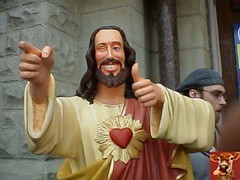
iJesus


Cool Jesus
Originally uploaded by isc_luis_herrera

I have the key to reaching the world for Jesus: We ride the popularity wave of the iPod, iPhone and iTouch and market a reinvented iJesus.

The traditional Jesus is as dated as 8-track tapes. In today's world, even CDs are being replaced by mp3s. We need a Savior who is technologically savvy.

We've been doing cross-marketing for years, what with the John 3:16 guy in the end zone and athletes thanking Jesus for helping them to be successful. We just need to be more diligent. Maybe we could buy the naming rights to Wrigley Field. How does Jesus Saves Stadium sound?

Of course, we'll have to update our logo. The cross is iconic, but overdone. We need a fresh, new twist. Even Pepsi has updated their logo.

We need a cool Jesus, one that will boost consumer confidence and turn around our economy.

If this sounds like a good idea, head over to ChristianityToday.com and read Jesus Is Not a Brand by Tyler Wigg-Stevenson. Here are a few quotes:

When it's just you and Jesus, you (the consumer) "invite him" (the product) "into your heart" (brand adoption) and "get saved" (consumer gratification).

If you feel like a used-car salesman talking about Jesus, the solution to the perceived lack of authenticity isn't a smoother pitch—it's a renewal of the church.

In a consumerist society, my identity comes from what I consume.

Spiritual consumers, therefore, will approach the church with the same narcissism they bring to other brands. What am I expressing about myself if I buy Brand Jesus? How will Christianity fulfill my vision for me?

Preaching and evangelism that focus on the benefits of becoming a Christian present a message not fundamentally different from commercial advertising about the existential benefits of this car or that soap.

We live in neighborhoods of single-family homes populated by people like us, go to church with people like us, consume media targeted at people like us, and shop with people like us. All of this makes us more reluctant to inhabit a world with people who are not like us.

If we treat the gospel like a commodity, can we fault nonbelievers for thinking that the cross is just another logo?

Spiritual consumers will come to Christianity as do window shoppers at a mall, wanting a spirituality tailor-made to their preferences.

Tyler focuses on evangelism, but consumerism is deeply embedded in North-American Christianity. It won't be long until we have Consumer Reports reviewing churches and rating the programs that they offer.

Pastor Rod

Saturday, October 04, 2008

Domesticating Paul


The Apostle Paul writes these provocative words in his letter to the Philippians (3:7–11):
But whatever was to my profit I now consider loss for the sake of Christ. What is more, I consider everything a loss compared to the surpassing greatness of knowing Christ Jesus my Lord, for whose sake I have lost all things. I consider them rubbish, that I may gain Christ and be found in him, not having a righteousness of my own that comes from the law, but that which is through faith in Christ—the righteousness that comes from God and is by faith. I want to know Christ and the power of his resurrection and the fellowship of sharing in his sufferings, becoming like him in his death, and so, somehow, to attain to the resurrection from the dead.


But modern-day Christians have taken all the sting out of them. We read them something more like this:
I have given up my old ways so that I can trade them in for God's declaration that I am righteous because of what Jesus Christ did for me. The most important thing to me is knowing that salvation is by faith in Christ and not by my trying to be good. I want to keep this straight in my mind and never forget that it is Jesus' death for me that makes it possible for me to get to heaven.


Not only is this not what Paul is saying, but it is nearly the opposite of what he is saying.


He means something more like this:
All those things that I used to count on to make me feel significant and accepted by God I now realize were worst than useless. In fact, all the things that seemed important I now consider sh*t, because my only hope is in my participation in the life that can only be found in Jesus Christ. The most important desire I have is intimacy with Christ Jesus who is my Lord. I yearn to experience the power of his resurrection at work in my life as I follow in the way of the cross. And while I enjoy life now that has an eternal depth, my ultimate hope is in the final resurrection when God's perfect kingdom will be realized.


Of course, that is just my clumsy attempt to paraphrase what Paul wrote in carefully crafted Greek that borders on poetry.


C. S. Lewis did a much better job in this poem:


As the Ruin Falls

All this is flashy rhetoric about loving you.
I never had a selfless thought since I was born.
I am mercenary and self-seeking through and through:
I want God, you, all friends, merely to serve my turn.

Peace, re-assurance, pleasure, are the goals I seek,
I cannot crawl one inch outside my proper skin:
I talk of love —a scholar's parrot may talk Greek—
But, self-imprisoned, always end where I begin.

Only that now you have taught me (but how late) my lack.
I see the chasm. And everything you are was making
My heart into a bridge by which I might get back
From exile, and grow man. And now the bridge is breaking.

For this I bless you as the ruin falls. The pains
You give me are more precious than all other gains.


That's what I was trying to say.


Pastor Rod
"Helping You Become the Person God Created You to Be"

Tuesday, September 09, 2008

Measuring Success Missionally

Conventional wisdom says that it is impossible to manage what is not measured. And in the church, we've been told "God cares about numbers because numbers represent people and God cares about people."

So under the banner of accountability and stewardship, church leaders collect statistics to measure the effectiveness of ministry.

Eventually, we end up with thinking like this:
A [church] that is falling far short of excellence will be motivated to improve by learning from consultants and other [churches] at the top of its peer group; the [church] will also be able to mark and show donors its quantitative progress toward measurable excellence. Meanwhile, top performing [churches] not only help other [churches] emulate their success, but they are also motivated to keep setting the standards of excellence even higher. Most importantly from the fundraising perspective, a [church] has an instant report card that it can show its donors (noting both areas of excellence and areas for improvement). Finally, if a networked [church] is to invest in a consulting team for help, it must be equipped with tools allowing it to challenge and motivate each [church] affiliate.
(Each occurrence of [church] replaces either "organization" or "non-profit.")

But the church is not a business. It is the body of Christ, a living temple of God's presence. And our evaluations need to reflect that reality. Yet not everything that counts can be counted.

It seems to me that there are several issues here:
  • God's kingdom is not identical with the church, even though there is considerable overlap.
  • Jesus Christ is the head of the church and builds his church in his own time and in his own way.
  • While we have responsibilities regarding the advancement of God's kingdom, many of those responsibilities are difficult or impossible to define in quantifiable terms.

  • Measurement has several pitfalls
    • If the wrong things are measured, the focus gets diverted from what is truly important.
    • Over emphasis on the numbers can lead to the assumption we are totally responsible for increases and declines.
    • The most important factors cannot be reduced to a number in a spreadsheet.
    • While "numbers represent people," most statistical systems reduce people to just numbers.
  • "Growth" easily becomes an idol with pressure to improve the numbers from the previous reporting period.

I suspect that collecting stories is more important than collecting statistics.

But if we were going to collect numbers, what numbers would be useful?

Doug Resler published a list of Missional Metrics written by Hugh Halter
  • Number of new relationships formed where I know their names and they know mine.
  • Number of people who have been uniquely blessed by me and my community.
  • Number of people who invite me to be with their friends who don't follow Christ.
  • Number of ways, my street, neighborhood, or community are more livable because of my influence.
  • Number of Christians that are actively confronting their consumerism and making adjustments at the life level.
  • Number of Christians that I ask or persuade NOT to go on mission with us.
  • Number of incarnational communities that commit to form around benevolent action instead of just a bible study.
  • How long people remain at our weekly gathering after the formalities are over.
  • Number of community-based initiatives our people are supporting with their time or money.
  • Number of young leaders we're intentionally developing.
  • Number of people baptized for the first time.
  • Number of Bibles purchased because someone asked for one.

These are helpful as pointers toward missional-incarnational living. But I wonder how well they avoid some of the problems I identified above.

We certainly want to evaluate certain aspects of missional-incarnational living:
Genuine relationships with people, not prospects
Missional-incarnational influence in the neighborhood
Discipleship that bites into real life
Healthy community (communitas)

Perhaps more helpful than numbers would be a rubric to help us evaluate each of these areas.

Here's a suggestion for Genuine Relationships from a personal perspective.
-1I have neighbors, relatives or co-workers that I am "not talking to."
0I get along with my neighbors, relatives and co-workers.
1I know the names of my neighbors.
2I know personal information about my co-workers such as birthday, anniversary, names of family members, hobbies.
3I have bought a gift for a friend just because I saw something I thought they'd like (not for a specific occasion).
4I have done a favor for someone anonymously.
5I have a relationship with a non-relative with whom I spend time at least weakly.
6I have a relationship with a person who does not attend my church, and we talk about spiritual things
7I have a relationship with a person who is not a follower of Christ, and we talk about spiritual things.
8I have a relationship with a person who is an atheist or agnostic and we talk about spiritual things.
9People frequently ask me to pray for them.
10I frequently offer to pray for people.
11I frequently pray for people when we are together and they mention a need.
12I have non-relatives in my home at least once a month (besides church groups).

This would be more helpful than a raw number. Similar rubrics could be developed for each of the values of missional-incarnational living. Rubrics could also be created for congregational evaluation.

I would be interested in any comments you might have to improve the suggested rubric and any suggestions you might have for other rubrics.

Pastor Rod
"Helping You Become the Person God Created You to Be"

Friday, July 11, 2008

Stating the Obvious[ly Wrong]

In the command known as the Great Commission, Jesus said, "go and make disciples of all nations, baptizing them in the name of the Father and of the Son and of the Holy Spirit, and teaching them to obey everything I have commanded you." Of course, we all know exactly what Jesus meant:

  • "Making disciples" means to seek the conversion of individuals.
  • The goal is to increase the number of Christians.
  • In order to be baptized, these individuals must repent, which means they must turn away from their sins.
  • The responsibility of the Church (and individual believers) is to bring unbelievers to a point of decision after presenting them with basic information about the content of the gospel.
  • After an individual is converted, then he or she learns the commands of Jesus and is encouraged to model his morality.
  • While both of these steps are important, the most important is conversion because it allows people to get into heaven.
  • A significant part of this Commission requires us to go (or send others) to other countries.
  • "All nations" refers to the countries of the world.


The problem is that each of these "obvious" facts is wrong.


But our understanding of this Commission has become ingrained in our church culture, and no one asks anymore what it means. Furthermore, many of these assumptions actually get in the way of the Church fulfilling its true mission.


If one regards it as the primary purpose of mission to increase the number of Christians and treats such increase as the criterion of success, without posing all the time the more radical questions which the gospel puts to the common assumptions of our culture, if the dominical call to "repent" is translated as "turn away from your sins" and there is no understanding of that radical overturning of the world's ideas of sin and righteousness and judgment, then there can be rapid church growth; but the very success of the burgeoning congregations may actually incapacitate them for a radical encounter with the culture into which they fit so comfortably. If religion is an affair for the private life, it can flourish in a society governed by other assumptions, taking the characteristic form which we know so well—a series of voluntary societies made up of people who share the same religious tastes. In that form Christianity can flourish, but it cannot challenge the beliefs that control public life. It has been co-opted into the culture.

Lesslie Newbigin, Signs Amid the Rubble: The Purposes of God in Human History, p. 91.


Besides, the advancement of the kingdom is not the Church's mission. It is God's mission:

Mission, then, is not essentially a human activity undertaken by the church and its leaders out of obligation to the Great Commission, gratitude for what God has done for us, and the desperate plight of the world. It is God's own mission in which we are invited to participate.

Stephen Seamands, Ministry in the Image of God, p. 161


So what is the mission of the Church?

The Christian mission is thus to act out in the whole life of the whole world the confession that Jesus is Lord of all.

Leslie Newbigin, The Open Secret, p. 17


This requires deep knowledge of God and more than a passing familiarity with the culture in which a particular congregation finds itself. It is God's embassy in a particular community.


The business of the church is to tell and to embody a story, the story of God's mighty acts in creation and redemption and of God's promises concerning what will be in the end. The church affirms the truth of this story by celebrating it, interpreting it, and enacting it in the life of the contemporary world. It has no other way of affirming its truth. If it supposes that its truth can be authenticated by reference to some allegedly more reliable truth claim, such as those offered by the philosophy of religion, then it has implicitly denied the truth by which it lives.

Lesslie Newbigin, Proper Confidence, p. 76


So what do you think? Do you still agree with some of the "obvious facts"? Are there other "obvious facts" that you'd like to debunk?


Pastor Rod

"Helping You Become the Person God Created You to Be"

Friday, January 25, 2008

Thank God for Mean People

Jesus said, "Blessed are you when men hate you, when they exclude you and insult you and reject your name as evil, because of the Son of Man" (Luke 6:22).

One reason we should be glad is that this treatment puts us in the company of the prophets. Thank God for mean people.

But another benefit is that this treatment drives us to God himself. It leaves us feeling empty and vulnerable. And if we follow Jesus' advice (and example) we return good for evil and we bless those who curse us. Thank God for mean people.

It hurts when people are mean out of selfish motives. But it is especially painful when they are mean "for your own good" or out of "love." This pain can drive us to despair or it can drive us to the One who knows all about betrayal. Thank God for mean people.

This also helps us to appreciate those who are kind, faithful and loyal—the ones we often take for granted. Thank God for mean people.

Failure has a way of leading us to a point of surrender, but it is a rather slow process. Personal attacks serve as an instant "wake up call." Thank God for mean people.

It's easy to allow our "Christ following" to become routine. We start to think, "I have a pretty good handle on this." We don't bother God with day-to-day stuff. We plan to ask for his help only when something really big comes up. But then mean people come to our rescue and remind us that we aren't self-sufficient at all. Thank God for mean people.

The way of discipleship begins with brokenness, emptiness and surrender. And few of us choose this on our own. We generally need some outside stimulus. Thank God for mean people.

It is only when we have enemies that we can learn to practice some of Jesus' most difficult words: "Love your enemies, do good to those who hate you, bless those who curse you, pray for those who mistreat you" (Luke 6:27–28). Thank God for mean people.

But it's also good to have kind people, gentle people, compassionate people, faithful people, good people, and loving people. Thank God especially for them.

Take the time to be extra kind, gentle, compassionate, faithful, good, and loving to the people you meet today. You really don't know how much they might need it.

Pastor Rod

"Helping You Become the Person God Created You to Be"

Monday, January 14, 2008

No More Biblical Principles

You can find people offering "Biblical Principles" for just about any subject:

So what's the problem?

The problem is that these "biblical principles" do not all agree and are often more an expression of culture than they are of any clear teaching of the Bible.

Just because something is stated in the Bible that doesn't mean it is a "biblical principle."

Some things are clearly presented as biblical principles, especially statements by Jesus. When Jesus said, "Bless those who curse you," he intended for it to be a guiding principle for his disciples.

But a passing statement in the Old Testament should not necessarily be turned into a "biblical principle."

The book of Proverbs is a collection of general truths. These are not "biblical principles" as the phrase is generally used. The precepts collected by Solomon and others require wisdom in their application. Some are even contradictory:

Do not answer a fool according to his folly, or you will be like him yourself (Proverbs 26:4).

Answer a fool according to his folly, or he will be wise in his own eyes (Proverbs 26:5).

Notice that these contradictory statements are found right next to each other. They were never intended to be "biblical principles."

The book of Psalms is a collection of Hebrew poetry. It is not a theology textbook. It is not a collection of "biblical principles."

Here is one of the milder imprecatory psalms:

Break the arm of the wicked and evil man (Psalm 10:15).

Surely that statement was not intended to become a "biblical principle."

The book of Job is a drama composed of speeches by Job, three of his friends, another guy who just shows up without explanation and God. God takes issue with what Job says. He repudiates the speeches of the three friends. And he ignores the comments of the other guy. There important theological lessons to be learned from Job's story. But be wary of any "biblical principles" that are based on proof texts from Job.

Statements made by God to Jeremiah (1:5) or through Jeremiah to the Israelites going into exile (29:11) are not "biblical principles" applying to Christians.

Actions taken by biblical characters are not necessarily templates for "biblical principles" to be applied to business, leadership or government.

Evangelicals seem to prefer a black and white world. They seek rules that they can blindly apply to every situation.

But being a disciple of Jesus Christ is not a paint-by-number project.

Let's have a little less talk about "biblical principles" and a little more focus on living as apprentices of Jesus Christ.

Jesus clearly avoided simplistic answers in his earthly ministry. Why would he want his followers to reduce his teaching now to simplistic rules?

Jesus did not call potential disciples to a code of conduct. He called them to follow him.

As a pastor, I must repent for all those sermons I preached when I said, "This is what the Bible says you should (not) do."

It's not my job to teach "biblical principles." My job is to say along with Paul, "Follow me as I follow Christ."

Pastor Rod

"Helping You Become the Person God Created You to Be"

Tuesday, November 13, 2007

Shiny Happy People

In 1991, REM released the song, "Shiny Happy People":

Everyone around / Love them, love them
Put it in your hands / Take it, take it
There's no time to cry / Happy, happy
Put it in your heart / Where tomorrow shines
Gold and silver shine.
Shiny happy people holding hands
Shiny happy people laughing.

While the song was a parody of a Chinese propaganda poster, it could well have been a satire of North-American Christianity.

It seems that we are obsessed with celebrity, wealth, power, attractiveness and success.

Even our counter-culture movements within the faith have their own celebrities.

Michael Spencer tells the story of a co-worker who certainly would not fit most people's image of the beautiful people.

One arm barely works. One eye is non-functional. One leg is almost immobile. He's deaf in one ear. One side of his head is terribly scarred. He's a soft-spoken, gentle man, but obviously life has not been gentle with him.

Yet this man is a spiritual giant.

Standing in front of our students, saying again and again that God is good. His suffering and loss can't be measured, but his faith has grown every step of the way. In his gentle, Minnesota accent, he says over and over, "God is good. I'm so thankful."

Jesus did not hang out with the popular folks. He spent his time with the outcasts, the untouchables. And those are the very ones that he built his church on.

So today, we spend our time trying to convince others that we are Somebody.

We spend money on our vanity, while others are starving.

We pour billions of dollars into entertainment to stave off boredom, while God is calling for people to participate in the greatest drama in the universe.

And we pastors are the worst offenders.

We've neglected the call to discipleship and self-denial and replaced it with the promise of a "happy life"—mostly because that is the dream that we are chasing.

God forgive us.

Pastor Rod

"Helping You Become the Person God Created You to Be"

Saturday, November 10, 2007

Not Safe for Worship

By now everyone knows that "not safe for work" means that media contain images or language that could get you fired if opened at work. Typically, that means items that are sexually explicit or that contain profanity.

Of course, this implies a dichotomy between "work life" and "private life."

Most people have also divided their lives into completely separate "sacred" and "secular" parts.

The "sacred" part involved "spiritual" stuff, which may include going to church on Sundays or saying prayers.

The "secular" part takes in everything else.

I had an experience just the other day that reminded me just how thick most people have made the wall between their "sacred" lives and their "secular" lives.

I was talking with a 40-year-old woman and her mother about the music they wanted to play at her (the daughter's) wedding. She said, "I was thinking about using this song I really like, but when I listened to it I realized that it was not appropriate for church."

I asked what the song was.

She said that it was "Imagine" by John Lennon.

I raised my eyebrows to say, "I'd reckon not." Then I tried to explain that the problem with the song was not that it was "inappropriate for church" but that it promoted a view of reality that was a complete contradiction of Christianity.

I didn't belabor the point and obviously didn't make my point clear.

She ended the short discussion with, "I really like the song, but it's not appropriate for church."

This is the kind of nonsense we end up with when we slice reality into two distinct parts.

This is the point the Apostle Paul was making when he said, "Whatever you do, do it all for the glory of God" (1 Corinthians 10:31).

If it is not safe for worship, it is not safe—full stop.

  • It's not enough that we try to practice Christian principles in our business. We must see our work life as part of our worship.
  • It's not enough that we try to be good sports in our recreation. We must see our play as bringing honor to God.
  • It's not enough that we try to avoid road rage. We must think of driving as an act of worship.

This reminds me of another shocking statement I heard this week. The president of a community organization that exists to promote good character said that she was reluctant to install a license plate holder endorsing the organization, because she was afraid that her driving might not be consistent with the ideals of "good character."

I used to be that way about identifying myself as a Christian driver.

But if we are going to be true followers of Jesus Christ, we must be serious about it when we are driving, when we are relaxing, and when we are listening to music.

There is no part of our lives disconnected from our worship.

Pastor Rod

"Helping You Become the Person God Created You to Be"

Tuesday, October 23, 2007

Wisdom from Willard

I'm listening to an audio of a seminar by Dallas Willard. Here are a few quotations:

If you want to succeed in discipleship, it has to be the most important thing in your life. And you have to understand that what you are going to get is worth so much more than what it's going to cost you that you will absolutely not let anything get in your way.

You are a disciple of Jesus if you are with him learning to be like him.

As a disciple I am learning from him how to lead my life as he would lead my life if he were I.

The meaning of the cross is the end of your life. It's no longer important for you to have your way.

If you abandon the pursuit of your [own] way then you are in a position to really begin to live.

What happens to people is that they go dead. They are not living in the drama that God intended to live in. Drama is absolutely crucial to our lives.

Idolatry always takes the form of using God for my purposes. And that can happen among professing Christians, and often does.

God intends to exalt you, but not on your terms. On his terms. And that's much better, I can assure you.

Salvation is being caught up in the life that Jesus is now living on earth.

The gospel is "trust Jesus Christ and walk into the kingdom of heaven here and now." Heaven will take care of itself, if you take care of heaven now. And you do this by trusting Jesus, not something he said or something he did.

Most of our teaching has been that you can't do the commandments of Jesus. And you can't if all you do is try. But if you also train as his disciple, there's not a single one of them that you can't do.

The only cure for lust is love. If you love people, you won't lust them.

I need more influences like Dallas Willard in my life. The church needs more serious disciples like Dallas Willard. The world needs to experience the kingdom through Christians who are like Dallas Willard.

May I be one of those people.

Pastor Rod

"Helping You Become the Person God Created You to Be"

Friday, August 31, 2007

Missional “in quotes”

The missional church rejects the association of Christianity with American values and the association of the church with entertainment, marketing, and corporate business models. The missional church is reading both Scripture and culture with new eyes. It sees that what is determined by the Christian faith is more than being a good, upright citizen. It sees the church as something different from the smooth corporate model of business. This emerging church calls for honest, authentic faith that seeks to be church in the way of a more radical discipleship.
Robert Webber, Ancient-Future Evangelism, p. 129

Contrary to the perception of many critics of the "missional/emerging" Church, the motivation is not to make following Christ more comfortable. The motivation is to take discipleship seriously, to take Jesus seriously.

Pastor Rod

"Helping You Become the Person God Created You to Be"

Saturday, August 18, 2007

Missional vs. Church Growth

Here's an excellent article by Gailyn Van Rheenen entitled Contrasting Missional and Church Growth Perspectives at www.missiology.org.

SheHe defines missional churches as "theologically-formed, Christ-centered, Spirit-led fellowships who seek to faithfully incarnate the purposes of Christ."

This definition is not all that helpful, because most churches would say that it describes them.

It is often more helpful to talk about what missional is not. And so she contrasts a missional approach to ministry with church growth philosophy.

Church growth employs "tools from the social sciences to analyze culture and to use this analysis to develop penetrating strategies for reaching both searchers and skeptics with the gospel of Christ." However,

Practitioners succumbed unintentionally to the humanistic suppositions of the Modern Era. Assuming that they could chart their way to success by their ingenuity and creativity, Church Growth practitioners focused on what humans do in missions rather than on what God is doing. They saw the missional task as setting goals, developing appropriate methodologies, and evaluating what does or does not work.

Here is a chart she provides that contrasts the various aspects of these two mindsets:

Missional

Church Growth

Orientation/ Perspective

Theocentric

Anthropocentric

Theological

Practical

Postmodern

Modern

Theological Focus

Missio Dei

Great Commission

Beginning Question

What is the gospel?

What makes the church grow?

Perspective on Scripture

Narrative of God's purposes

Propositional truth

How does missions happen?

By the Spirit (God's "surprises")

By strategic planning

Nature of community

Inclusiveness, unity of the body of Christ

People groups

Focus of Evangelism

Initiation of people into the kingdom of God; holistic understanding of "making disciples"

Differentiation between discipling and perfecting, individual salvation

Orientation toward Social Action

The Gospel, evangelism, and social action cannot be separated

Priority of evangelism and church planting over social action; Reactive to the Social Gospel

(The emphasis is mine.)

Church growth is pragmatic by design, "Church growth determines effective practice and then seeks to validate this practice by the use of Scripture. The movement emphasizes growth rather than faithful proclamation of the gospel and faithful living of the gospel."

SheHe advocates what she calls The Missional Helix. It is composed of four elements: Theological reflection, Cultural analysis, Strategy formation & Historical perspective.

The diagram is a helix because theology, history, culture, and the practice of ministry build on one another as the community of faith collectively develops understandings and a vision of God's will within their cultural context. Like a spring, the spiral grows to new heights as ministry understandings and experiences develop (emphasis in original).

In my experience, there are many who see the missional approach as simply a new form of church growth thinking. Perhaps this article will help demonstrate the difference.

Pastor Rod

"Helping You Become the Peron God Created You to Be"

Wednesday, June 27, 2007

Effective Preaching

As a follow up to my criticism of one style of preaching, I thought I'd share with you this post by Brian Russell. He lists six principles for "preaching that connects":

  1. Prayer is essential.
  2. God is working in your life.
  3. Find Your Own Rhythm and Style
  4. Understand Your role as an Interpreter
  5. Share Yourself.
  6. Bring Passion to the Delivery

I agree with him on the importance of these things. They all (except number 4) depend upon what is happening in the life of the preacher.

Bishop William Alfred Quayle said:

Preaching is not the art of making a sermon and delivering it; it is rather the art of making a preacher and delivering that.

It is difficult to explain the proper role of prayer in the preparation of the sermon. It is more like a total dependence upon God that permeates every part of life and spills over into the preparation and delivery of the sermon.

It seems to me that there are three keys to effective preaching (in the order of importance):

  • Know God
  • Know yourself
  • Know your listeners

It is possible to read this list and understand "know" in a very shallow way. But there must be a depth to this knowledge. It is an awareness and familiarity that becomes stronger over time.

Knowing God means much more than having a solid theological foundation. It means having a "relationship" with him as one would with any other person. Unfortunately, this phrase has become a cliché and lost nearly all its meaning.

To know yourself requires more than taking the Myers-Briggs Type Indicator or knowing whether you are an auditory, visual or kinesthetic learner. It means knowing the temptations that you are most susceptible to. It means knowing your deepest desires, not just what you think you want. It means having an objective recognition of your strengths and weaknesses. It means being conscious of what you think and feel.

And knowing your listeners goes far beyond "knowing your audience." It means really knowing the individuals sitting there and what is happening in their lives

On the one hand, this is very difficult. But on the other hand, it is natural and "effortless." I used to stress over my sermon preparation. Because I wanted to "do my best." I now have a more focused, relaxed attitude. It is not my job to convince, convert or change my parishioners. It is my job to be in the process of becoming more like Jesus Christ and to share that journey with the people God has entrusted me with.

The real work of sermon preparation is not done sitting in front of my computer. It is done in my heart/soul/spirit as I cooperate with God's grace as he makes me into the person he created me to be.

Pastor Rod

"Helping You Become the Person God Created You to Be"

Tuesday, June 26, 2007

Rules & Regulations

I have written before about the theological, cultural and exegetical mess of the membership requirements of The Wesleyan Church. I strongly believe that the whole idea of having such a list is wrong-headed. And its practical result is that it short-circuits the process of serious discipleship.

I read this post by my fellow-Wesleyan Ken Schenk. In the context of free academic dialogue I would like to respond to several points he makes. (Ken's words will be in red.)

The Wesleyan Church is not the universal church. It would be both silly and unwise to pretend like our identity is simply that of generic Christianity. Membership identity in a denomination is not a question of "What is a Christian?" or "What does the Bible require of a person to be a Christian?"

I agree that The Wesleyan Church is not the sum total of the universal church. But how does it differ from "generic Christianity"? Are we somehow superior? Are we the Jesuits of the holiness movement?

Ken argues that denominational membership should not be determined by what the Bible requires to be a follower of Jesus Christ. But here's what The Discipline says:

No person who loves the Lord Jesus Christ, and obeys the gospel of God our Savior, ought to be deprived of church membership (p. 27).

This seems to be in direct conflict with Ken's point. The Wesleyan Church seems to think that only those who keep the membership commitments are obeying "the gospel of God our Savior." Besides, what does it mean to obey the gospel? I don't follow the logic.

In a section describing the history of The Wesleyan Church, there is this statement:

The Covenant Membership Commitments found in this Discipline
(260-268) represent in revised form the General Rules which Wesley gave to
the members of the societies to enable them to test the sincerity of their
purpose and to guide them in holy living (p. 3).

In effect, The Wesleyan Church has taken rules that Wesley set up for discipleship groups and used them as membership rules for a denomination. These rules earned the Wesleys and their followers the pejorative of "Methodists."

Ken continues:

Most of those who frame membership requirements in this way reflect fundamental blind spots in the way they think. For one, the Bible did not set down its requirements with a view to 21st century America and the broader world. Its books addressed various contexts in the ancient world. To think our membership requirements would simply be a mirror of what the Bible required them reflects a fundamental misunderstanding of the contexts of biblical instruction.

I'm not sure what membership commitments have been developed as a result of the special challenges of the 21st century. Wesley's rules for his class meetings were conceived in the 17th century, and The Wesleyan Church (as The Wesleyan Methodist Connection) was established in the 19th century. I think the critics of the membership requirements would welcome some reflection on what church membership means in the 21st century.

With respect to Ken (And I have a great deal of respect for him.) it strikes me as disingenuous to dismiss all appeals to the biblical text as naïve.

Ken argues:

Secondly, to make the identity of The Wesleyan Church into "every church"--as if we obviously would only require what God requires of every Christian, the lowest common denominator of all Christians--is to insist that the ears be the eyes be the feet be the nose.

Paul's metaphor about the body was addressing the differing roles of individuals. To apply this to whole denominations is to do violence to the point that he was making. Would we think that it is healthy to have a congregation made up just of elbows? Who wants an entire denomination made up of spleens?

Ken seems to think that the membership commitments alone give The Wesleyan Church a "personality." Unless we tack on special requirements for church membership, we will lose our identity.

Ken again employs elitist language, decrying "lowest common denominator" requirements. But how does this square with Acts 15:28–29?

It seemed good to the Holy Spirit and to us not to burden you with anything beyond the following requirements: You are to abstain from food sacrificed to idols, from blood, from the meat of strangled animals and from sexual immorality. You will do well to avoid these things.

This was a response to cultural differences between the Jewish believers and the Gentile believers. The Apostles (and the Holy Spirit!) seemed to be looking for minimal requirements. Christianity cut itself free from cultural ties very early.

Ken shifts to his second point:

Denominations do a service to the body of Christ when they do "their thing" well. The Amish do forgiveness well. The question we Wesleyans need to be asking as we look to our denominational identity and our membership requirements is "What do we do well?" Optimism of grace comes to mind, victory over sin as a doctrine, social compassion was mentioned in my small group at the conference.

How do membership commitments translate into "what we do well"? Is there any relationship between the Amish wearing long beards and eschewing electricity and their willingness to forgive a mass murderer? (Maybe we need to develop a "Wesleyan uniform" so that don't lose our identity.)

We certainly have victory over sin as a doctrine, but do we have it as a reality? Do our membership requirements encourage people to be vulnerable and transparent about their struggle with sin (as an essential step to obtaining victory over it) or do they institutionalize duplicity and dishonesty? Does refusing membership to anyone who has a glass of wine (at a wedding, for example) advance the cause of social compassion? Do smokers feel optimistic when they are excluded?

Peter's words seem appropriate here:

Why do you try to test God by putting on the necks of the disciples a yoke that neither we nor our fathers have been able to bear? (Acts 15:10).

I wonder how far Ken would be willing to apply his principle that every denomination has the right to establish whatever requirements that it wants. What if a denomination forbad the eating of pork? Or required circumcision?

And I have not even addressed the rank hypocrisy that we have tolerated within our ranks. We have turned materialism into a virtue as long as donors give to our churches and institutions. We encourage gluttony while denouncing the dangers of "social drinking." We make excuses for pastors and church officials who are mean and rude, because they are "effective."

I'd very much like to see The Wesleyan Church become a demonstration of the power of God's grace to overcome the grip of sin. But I don't see our current membership requirements as a means toward that end. Rather, I see them as a significant obstacle.

That's what I think. What do you think?

Pastor Rod

"Helping You Become the Person God Created You to Be"

Saturday, June 09, 2007

Willard on Church Planting

Dallas Willard makes these provacative statements in a presentation that you can listen to at www.allelon.org:

The church is God's operation on earth.

We don't build churches. We preach the kingdom, make disciples, bring them together in the presence of God, and grow them. And the church results. And then it has a further activity. But the one who is in charge of his church is Jesus Christ.

When Jesus sent his people out into the world, he did not send them to plant churches. He sent them to establish beachheads of the kingdom of God. And churches would be the natural result of that. And then they would carry on that work. But the primary work is the action of God among the people who go out with faith in Jesus Christ to make disciples to him.

Not only are our efforts ineffective, but they actually prevent us from us becoming channels that God can use to advance his kingdom. Here's some more from Willard:

Grace is God working in our lives to do what cannot accomplish on our own.

What you really believe about Jesus Christ is shown by what you do after you learn that you can't do anything.

Spiritual formation is not learning to do the right things.

Here is the irony. What we do really matters.

But the only effective action we can really take is to trust in God's grace.

The harder we try to "make things happen," the less we trust in God's grace.

This is neither simple nor easy.

And people who should know better get in the way of this instead of facilitating it.

Tell me what you think. Do you agree with Willard? Have you experienced this dynamic at work in your own life?

Pastor Rod

"Helping You Become the Person God Created You to Be"

Saturday, June 02, 2007

Ministry by Hanging Out

If Jesus were a pastor, how would he spend his time?

How much time do you think he would spend . . .

writing job descriptions?

attending committee meetings?

overseeing the construction of a new building?

designing a direct-mail postcard?

raising money?

organizing programs?

writing sermons?

developing strategic plans?

He didn't seem to be very concerned about these things when he was training the very first members of the whole Church.

He spent a fair amount of his time speaking to gathered crowds. But most of his time appears to have been invested in just hanging out with his disciples. Here are just a few examples:

Leaving Nazareth, he went and lived in Capernaum (Matthew 4:13).

As Jesus was walking beside the Sea of Galilee, he saw two brothers (Matthew 4:18).

Jesus went throughout Galilee (Matthew 4:23).

Now when he saw the crowds, he went up on a mountainside and sat down. His disciples came to him, and he began to teach them (Matthew 5:1–2).

When he came down from the mountainside, large crowds followed him (Matthew 8:1).

Then he got into the boat and his disciples followed him (Matthew 8:23).

While Jesus was having dinner at Matthew's house, many tax collectors and "sinners" came and ate with him and his disciples (Matthew 9:10).

That same day Jesus went out of the house and sat by the lake. Such large crowds gathered around him that he got into a boat and sat in it, while all the people stood on the shore (Matthew 13:1–2).

As Jesus and his disciples were leaving Jericho, a large crowd followed him (Matthew 20:29).

As Jesus was sitting on the Mount of Olives, the disciples came to him privately (Matthew 24:3).

While Jesus was in Bethany in the home of a man known as Simon the Leper . . . (Matthew 26:6).

Once again Jesus went out beside the lake. A large crowd came to him, and he began to teach them (Mark 2:13).

One Sabbath Jesus was going through the grainfields, and as his disciples walked along, they began to pick some heads of grain (Mark 2:23).

Jesus and his disciples went on to the villages around Caesarea Philippi. On the way he asked them, "Who do people say I am?" (Mark 8:27).

After Jesus had gone indoors, his disciples asked him privately . . . (Mark 9:28).

They came to Capernaum. When he was in the house, he asked them, "What were you arguing about on the road?" (Mark 9:33).

Jesus then left that place and went into the region of Judea and across the Jordan (Mark 10:1).

When they were in the house again, the disciples asked Jesus about this (Mark 10:10).

They were on their way up to Jerusalem, with Jesus leading the way (Mark 10:32).

As Jesus was sitting on the Mount of Olives opposite the temple, Peter, James, John and Andrew asked him privately . . . (Mark 13:3).

He went to Nazareth, where he had been brought up, and on the Sabbath day he went into the synagogue, as was his custom (Luke 4:16).

While Jesus was in one of the towns, a man came along . . . (Luke 5:12).

Now one of the Pharisees invited Jesus to have dinner with him, so he went to the Pharisee's house and reclined at the table (Luke 7:36).

Once when Jesus was praying in private and his disciples were with him, he asked them . . . (Luke 9:18).

As they were walking along the road, a man said to him . . . (Luke 9:57).

As Jesus and his disciples were on their way . . . (Luke 10:38).

One day Jesus was praying in a certain place. When he finished, one of his disciples said to him, "Lord, teach us to pray" (Luke 11:1).

On the third day a wedding took place at Cana in Galilee. Jesus' mother was there, and Jesus and his disciples had also been invited to the wedding (John 2:1–2).

Jacob's well was there, and Jesus, tired as he was from the journey, sat down by the well (John 4:6).

As he went along, he saw a man blind from birth. His disciples asked him . . . (John 9:1–2).

Now, some will argue that "just hanging out" is irresponsible and unfocused. But they miss the point. Properly understood hanging out is more like a spiritual discipline. Intentional hanging out is costly.

So what do you think?

Pastor Rod

"Helping You Become the Person God Created for You to Be"

Tuesday, March 13, 2007

Slow Down!

Watch this video of a recent TED presentation by Carl Honore, author of In Praise of Slowness.

He says that it is time for us to get in touch with our "inner tortoise." We need to rebel against the "roadrunner culture." And he is not alone. There is an International Slow Movement which started in Italy. Its two main branches are Slow Food and Slow Cities. There is also an emphasis on slow sex.

Adults are not the only ones suffering from this frenetic pace. Our children are also overwhelmed with organized activities and homework.

And so this movement is trying to bring some peace and sanity to modern life.

Mahatma Gandhi said, "There is more to life than increasing its speed."

Steven Wright joked, "I think God is going to come down and pull civilization over for speeding."

But for Christians, the pace of life is about more than productivity or even happiness. It is a spiritual issue. The slow movement was started several thousand years ago by God himself.

The purpose of the Sabbath was to allow, even to force, people to slow down.

God knew Parkinson's Law (Work expands to fill the time available for its completion.) long before people studied such things. That is one reason that he did not allow any work to be done on the Sabbath. (Not even servants or animals could work.) The Sabbath was also a constant reminder that the people depended upon God for their security and prosperity.

I am not an advocate of returning to Sabbatarianism. But I do think that we have a serious problem with stress and busyness.

One antidote to busyness is solitude:

Solitude well practiced will break the power of busyness, haste, isolation, and loneliness. You will see that the world is not on your shoulders after all. You will find yourself, and God will find you in new ways. Joy and peace will begin to bubble up within you and arrive from things and events around you.

Dallas Willard, The Great Omission, p. 36

We need to realize that a chaotic life is not only bad for our physical, emotional and spiritual health. But it is also an expression of distrust of God. This is part of what Jesus was talking about when he said to seek first the Kingdom of God (Matthew 6:33).

So what do you think? How serious is this problem? What are some disciplines you use for slowing down?

Rod

"Helping You Become the Person God Created You to Be."

Thursday, February 15, 2007

Drawing Lines

My denomination has membership commitments that are (at best) anachronistic. They draw a clear “line in the sand” defining who can and who cannot become members of any local church.

For the moment, I want to set aside the fact that this line is drawn in the wrong place.

I want to address, instead, the whole rational of lifestyle membership regulations. There is biblical warrant for a very limited number of lifestyle “concessions” (
Acts 15:19–21). But they are clearly concessions, and there are only four of them.

Trying to define what serious discipleship looks like creates all sorts of cultural problems. These definitions, by nature, lag behind the rapidly-changing culture. By the time they are written, they are out of date.

They also tend to emphasize things that are not important and to overlook things that are important.

Leslie Newbigin points out the well-documented errors that western missionaries have made in this regard:
The place where the virus of legalism gets into the work of evangelism is the place where the evangelist presumes that he or she knows in advance and can tell the potential convert what the ethic content of conversion will be.
Leslie Newbigin, The Open Secret, p. 136
Much as the act of measurement irrevocably alters a quantum event, the attempt to delineate rules, or even guidelines, imposes a time-bound and culture-bound reduction on the gospel.

We can see this clearly with groups like the Amish. But most evangelical Christians are different from them only in the degree to which their cultural regulations lag behind the current time.

But the real danger is much more serious. A detailed list of lifestyle regulations inevitably turns Christians into Pharisees. They had a list of activities which were forbidden on the Sabbath; we have a list of activities, associations and occupations that are forbidden for membership.

With such a list, we tend to focus on the periphery, thinking about what is allowed and what is forbidden. Our focus should not be on the periphery, but on the center, Jesus Christ. Again Newbigin has a good word:
When the light shines freely one cannot draw a line and say, “Here light stops and darkness begins.” But one can say and must say, “There is where the light shines; go toward it and your path will be clear; turn your back on it and you will go into deeper darkness.”
Leslie Newbigin, The Open Secret, p. 175

These kinds of regulations actually discourage serious discipleship. Paul addressed this in Colossians 2:21, 23:

“Do not handle! Do not taste! Do not touch!” Such regulations indeed have an appearance of wisdom, with their self-imposed worship, their false humility and their harsh treatment of the body, but they lack any value in restraining sensual indulgence.

They seem reasonable, but they have no real value in producing holiness.

These kinds of rules cause harm as Dallas Willard warns:

If in spiritual formation you focus on action alone, you will fall into the
deadliest of legalisms and you will kill other souls and die yourself. You will get a social conformity…. To focus on action alone is to fall into pharisaism of the worst kind and to kill the soul.
Dallas Willard, The Great Omission

But this is not an issue of balancing freedom with obligation. This is not an issue of how much we should accommodate to the host culture.

Paul was not sliding down some slippery slope. He was not “becoming liberal.” In the very next verse, he continues:

Since, then, you have been raised with Christ, set your hearts on things above, where Christ is seated at the right hand of God. Set your minds on things above, not on earthly things…. Put to death, therefore, whatever belongs to your earthly nature: sexual immorality, impurity, lust, evil desires and greed, which is idolatry…. You must rid yourselves of all such things as these: anger, rage, malice, slander, and filthy language from your lips. Do not lie to each other, since you have taken off your old self with its practices and have put on the new self, which is being renewed in knowledge in the image of its Creator…. Therefore, as God's chosen people, holy and dearly loved, clothe yourselves with
compassion, kindness, humility, gentleness and patience. Bear with each other and forgive whatever grievances you may have against one another. Forgive as the Lord forgave you. And over all these virtues put on love, which binds them all together in perfect unity…. And whatever you do, whether in word or deed, do it all in the name of the Lord Jesus, giving thanks to God the Father through him.
Colossians 3:1–2, 5, 8–10, 12–14, 17
When we give people a list of what they should do and what they should not do, we change the dynamic of discipleship. This does not mean that discipleship has no demands. It means just the opposite. Discipleship demands much more than simply keeping a list of rules.

Michael Frost could be talking about a rule-based approach to holiness:

This version of Christianity is a façade, a method for practitioners to appear like fine, upstanding citizens without allowing the claims and teachings of Jesus to bite hard in everyday life.
Michael Frost, Exiles

In its essence, discipleship is about developing character from the inside out. It is about the kind of people we are becoming.

Spiritual formation for the Christian is a Spirit-driven process of forming the inner world of the human self –our “spiritual” side—in such a way that it becomes like the inner being of Christ himself. In the degree to which such a spiritual transformation to inner Christlikeness is successful, the outer life of the individual will become a natural expression or outflow of the character and teachings of Jesus.
Dallas Willard, Living A Transformed Life Adequate To Our Calling
Jesus said that anyone who wants to be a disciple must deny himself, take up his cross daily and follow the example of Jesus. He said that true disciples are becoming the kind of people who naturally turn the other cheek. They are people who bless those who curse them.

Paul said that true disciples can be easily identified by their love, joy, peace, patience, kindness, goodness, faithfulness, gentleness and self-control.

But I’ve shifted this discussion from membership to discipleship. This is a shift that is often made unconsciously when arguing the question of membership commitments. An argument is made for what a mature Christian should look like (from the point of view of the person making the argument) and that is translated into membership requirements.

But is it reasonable to require of church members the characteristics of Christian maturity?

Do we allow only healthy people into hospitals? Do we enroll in college only students who already have a command of the subject for which they desire a degree? Do we leave our children at an orphanage until they can take on adult responsibilities in our families?

But somehow we think it is reasonable to expect maturity at birth when it comes to the spiritual life.

Some would argue that we shouldn’t just let anyone become a member of our churches. I agree. We should limit membership to baptized believers who are serious about following Christ.

There is no correlation between the nonconsumption of alcohol and the desire to be a serious disciple of Jesus. The same could be said regarding smoking.

Anytime an organization draws a line of required behaviors, those behaviors tend to clump on either side of the line. As a church, we shouldn’t be calling people to cross our lines. We should be calling people to become more and more like Jesus.

The early church didn’t have detailed membership requirements. Peter even had to revise his presumed requirements on the spot in the home of Cornelius (Acts 10:47). And while the early church had a few problems, there was a vitality and commitment that we rarely see today.

This does not mean that leaders should never label certain actions as sin. The truth is that we need more of this. But our membership rolls will become very short indeed if we only accept those who are free from any sin.

There are many arguments for supporting the status quo.
  • We should submit to the authority of the church.
  • We should respect the tradition from which we’ve developed.
  • We should honor our spiritual “fathers.”
  • We should limit our freedom so as not to offend the “weaker brothers.”
Quietly accepting the status quo is the easy position to take. But is it the right position to take?

A good friend once asked me, “Do you really want to be known as the person who made drinking permissible in the Wesleyan Church?” (His point was that we only get one legacy and that we need to choose it wisely.)

Framed in this way, the obvious answer is “No; I’d rather be known for something more important.”

But what about being known for calling the Wesleyan Church to be serious about true discipleship, about a compelling and powerful holiness that is a true work of God?

I think I could reply with a “Yes” to that.

Pastor Rod

“Helping You Become the Person God Created You to Be”